
The Sentence That Ruins the Meal
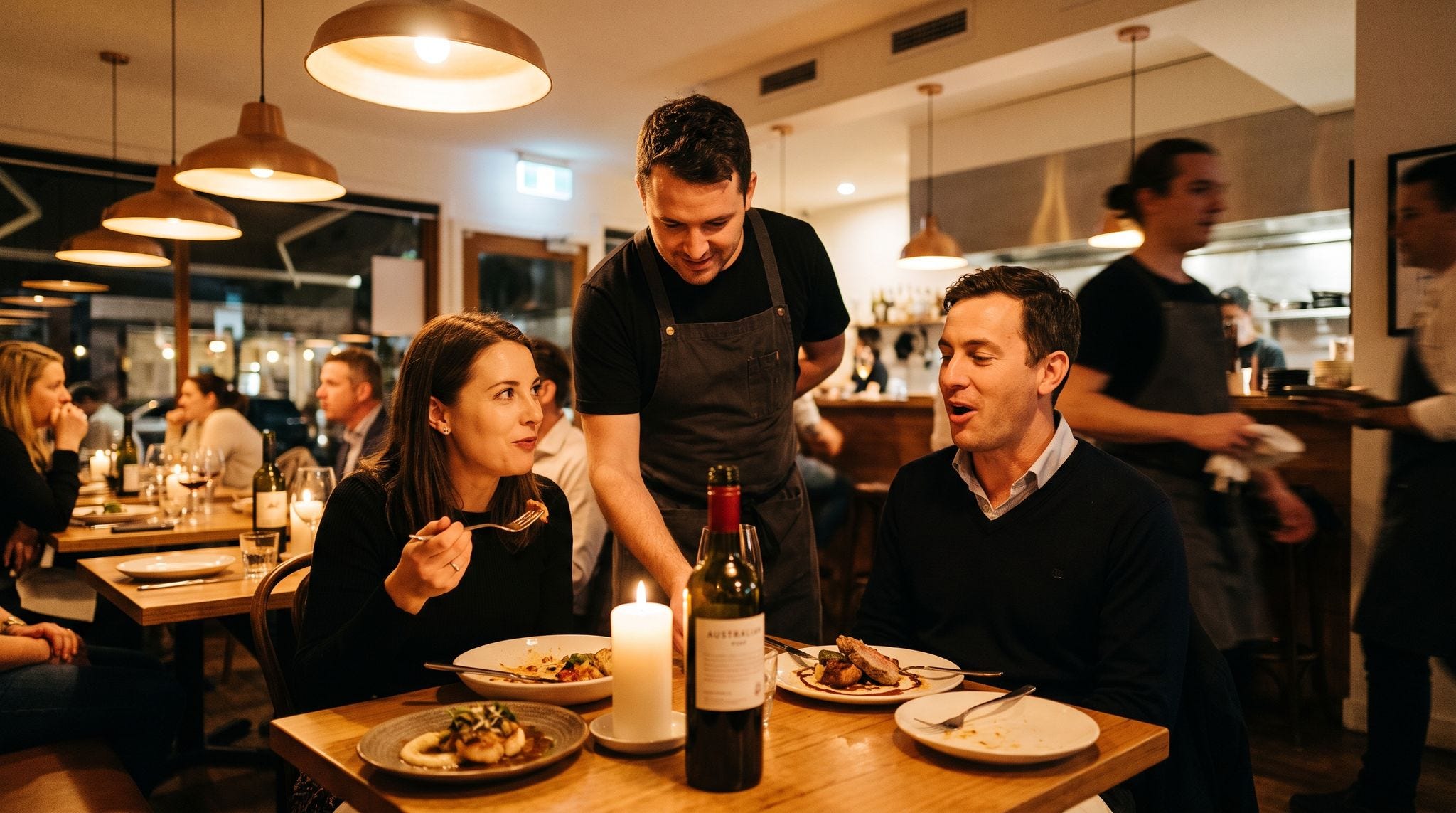
The food was exceptional. The kitchen had been firing all night.
The sommelier had read the table well: suggested a bottle at a price point that felt like a recommendation rather than an upsell, explained why it worked with what we'd ordered, and left us to it. The pacing was right. The room had the kind of energy you feel when a venue is operating at full capacity and doesn't seem to know it's working hard.
And then a waiter arrived four minutes into the main course and said seven words.
"Is everything all right for you?"
We said yes. Of course we said yes. Everyone says yes. The waiter nodded and disappeared back into the floor, having confirmed nothing, learned nothing, and briefly interrupted a conversation that had been going rather well.
What he was trying to do was right. Check in. Show attentiveness. Make sure we were happy.
What he actually did was build a frame so narrow the only possible exit was a polite dismissal.
That's not a training problem in the traditional sense. Nobody taught him bad technique. The issue is deeper. He had no understanding of how the structure of a sentence, not just the intent behind it, shapes what the person on the other end is able to feel, think, and tell you.
And that gap runs through the entire hospitality industry.
Language Doesn't Support the Experience. It's Part of It.
Let me be precise about what this article is and isn't arguing.
It isn't arguing that better scripting will extract more money from guests. That framing is both wrong and dangerous: guests can feel when language is being deployed on them rather than with them, and when they feel it, you've lost something that no amount of technical service can recover.
The argument is this: you can build a remarkable product (exceptional food, a well-trained team, a room with real atmosphere, beverage credentials that justify the list) and have all of it undermined at the critical moments by language that creates the wrong frame. The guest doesn't always know why the experience felt slightly flat. They don't sit down afterwards and diagnose which sentence broke the spell. They just know something was off. And that feeling is what ends up in the review.
The reverse is equally true. When language is right, when every touchpoint from the first phone reservation to the final farewell builds the same frame, guests don't experience a meal. They experience a place they want to be part of. The question of whether to spend more, stay longer, or book again doesn't arise the same way it does for a guest who's been managed rather than hosted. The ceiling lifts because the experience itself has warranted it.
This is the only commercially interesting version of the argument. Not "use better language to sell more." Use better language so that guests feel so well looked after that spending more is the natural expression of how they feel about being there.
These are not the same thing. The difference is felt by every guest at every table, even if they can't name it.
So what does language that honours the experience actually look like, and what does the alternative cost you?
How a Sentence Creates a Frame
Before we get to specific technique, the principle needs to be clear.
Every sentence spoken in a hospitality context creates a frame, an invisible set of assumptions, inside which the guest operates. That frame shapes what the guest believes is possible, expected, and appropriate. It shapes their emotional state. It shapes how they interpret what happens next.
Most of the time, this is happening unconsciously on both sides. The waiter isn't thinking about the frame he's creating. The guest isn't consciously analysing the sentence. But the effect is real and it accumulates across every interaction from arrival to departure.
The waiter's "Is everything all right?" created a frame of potential concern. A frame that asked the guest to assess whether something had gone wrong, before they'd had time to form a meaningful view. The only frame available to the guest was binary: fine, or not fine. Since nothing was dramatically wrong, "fine" was the only honest answer.
Contrast that with a sentence that creates a different frame.
"When you've had a chance to try the duck, I'll come back and hear how it's landed for you."
Read that again. The frame this sentence creates is entirely different. It assumes the guest will form an opinion worth sharing. It assumes the dish has merit worth anticipating. It commits the waiter to returning, not as a check-in, but as a continuation of a conversation that hasn't happened yet. And it gives the guest permission to have a real response, rather than a polite one.
The dish is identical in both scenarios. The intent is probably identical too: both waiters want the guest to be happy. But one sentence creates a frame where genuine communication is possible. The other closes it off before it opens.
This is what language mechanics actually means in practice. Not scripts. Not manipulation. The deliberate construction of sentences that create the conditions under which a real guest experience can occur.
The First Mechanic: Building the Right Assumption Into the Sentence
There's a specific name for what's happening in the examples above. A presupposition is an assumption embedded in the structure of a sentence, not stated directly, but accepted by the listener's brain before they engage with the content.
Most people have never thought about this consciously. But every sentence contains presuppositions. The question is whether yours are building the experience or quietly eroding it.
To make this concrete, consider the reservation conversation.
A guest calls to book. The standard framing: "Would you like a table for Saturday evening?" Technically fine. But the frame is neutral. There's no reason inside that sentence for the guest to feel anything in particular about the experience they're heading toward.
Compare: "Saturday evening, are you thinking of coming early and settling in, or later in the evening when the room really gets going?"
Now something different is happening. The guest has been given a reason to anticipate the experience before they've been near the restaurant. The assumption embedded in the sentence is that the room has a quality worth orienting the visit around. The guest has already begun forming a picture.
Or consider menu language. A standard entry: "Pan-seared salmon fillet, seasonal vegetables, lemon butter sauce." Accurate. Inoffensive. Creates no frame whatsoever.
“Tasmanian salmon, pan-seared: caught two days ago, served with roasted heritage carrots and a cultured butter sauce that's become something of a signature for our head chef.?
The dish hasn't changed. The presupposition has. The assumption embedded in the second version is that this dish has a story, that provenance matters here, and that the kitchen has invested real thought into what lands on the table. The guest hasn't tasted anything yet. Their experience of the dish has already begun.
This applies everywhere. Pre-shift briefings. Guest recovery conversations. Pricing communication. The standard framing on any of these creates one set of assumptions. A deliberately constructed sentence creates another.
The test is always the same: what does this sentence cause the guest, or the team member, to assume is true, before they respond? Is that assumption the right one? If it isn't, rewrite the sentence until it is.
The Second Mechanic: Building Forward Motion Without Pressure
The second tool is different in kind. Where a presupposition shapes the frame, a double bind shapes the direction of movement within it.
A double bind offers two options, both of which lead to the same outcome. The listener has genuine choice. The direction of travel is set.
This sounds more technical than it is. In hospitality, it shows up most naturally in the moments where a conversation could either move forward or stall.
Guest recovery is the clearest example. Left unstructured, recovery conversations default to the most assertive party winning. A confident guest escalates and names what they want. A polite guest says it's fine when it isn't, leaves dissatisfied, and writes the review from the car. Neither outcome is designed: it's whatever the social dynamics produce.
A well-constructed recovery conversation looks different. The manager approaches with a clear frame and two genuine options: "Would you prefer I bring you a replacement dish now so we can continue the evening properly, or shall I come back at the end and we'll make sure the account reflects tonight accurately?"
Both options resolve the issue. Both assume resolution: the question of whether the situation will be addressed has been removed from the frame entirely. The guest has agency over how it's addressed. Nobody is put in the position of naming a figure or escalating. The conversation moves forward with dignity intact on both sides.
That's the important thing about this tool. It only works, ethically and commercially, when both options are genuinely available and genuinely acceptable. A double bind where one option is a trap isn't influence architecture. It's pressure. Guests feel the difference, even when they can't name it.
Applied to the floor: "Are you thinking of letting dinner take its natural pace tonight, or would you prefer we build it around a later engagement?" Both options tell the team something useful about how to run the table. Both make the guest feel that the experience is being shaped around them, not processed through a standard sequence.
Applied to wine: "Would you like to take a look at the wine list, or would you prefer the sommelier to suggest something that works with what you've ordered tonight? Or, we can just open the first bottle and let it speak for itself."
The first two options form the double bind: both assume engagement with the wine decision, the direction is set. The pause before the third option preserves that structure while doing something different: it signals that the waiter has read the room and is offering a genuine exit to the guest who doesn't want to be inside any frame at all. The bind holds. The third option is an act of intelligence, not a concession. Nobody is bypassed. Nobody is managed. Nothing feels like a sell.
The System: What This Produces When Both Work Together
These two mechanics don't operate in isolation. Used together, they form the language infrastructure of a guest experience that feels genuinely looked after.
Before a conversation begins, the presupposition has already set the frame: what the guest assumes is possible, expected, and worth anticipating. Once the conversation is in motion, the double bind keeps it moving forward, toward a resolution that serves the guest and the business simultaneously.
Here's what that looks like in the most important service moment of any evening: the point at which a guest's experience has fallen short of what it should have been, and a manager has maybe sixty seconds to either recover the relationship or lose it for good.
Without language architecture, this conversation is improvised. The manager apologises. The guest decides how hard to push. The outcome depends on who's more comfortable in the silence.
With it: "I can see tonight hasn't landed the way it should have. Would you prefer we address it now with something from the kitchen, give us a chance to finish the evening well, or shall we sit together at the end and I'll make sure the account is right?"
Two things are happening simultaneously in that sentence. The presupposition, "tonight hasn't landed the way it should have", acknowledges the gap without qualification or defensiveness, and embeds the assumption that the restaurant's standard is higher than what was delivered. The double bind, both options assume resolution, removes avoidance from the frame entirely.
The guest hears: this business has standards, they know tonight missed them, and they're committed to addressing it. Not "I'm sorry you feel that way." Not "what would you like me to do about it?" Commitment and direction, without pressure.
That's the experience the guest talks about afterwards. Not the thing that went wrong: the way it was handled. And that conversation, built properly, produces more goodwill than fifty unremarkable evenings that went exactly to plan with average (⭐⭐⭐) to good (⭐⭐⭐⭐) reviews.
What This Actually Costs
None of what's described here requires a new system, a technology platform, or a budget line.
It requires operators who understand that language is not the garnish on the experience. It's the frame within which the experience is received. The greatest kitchen in the country, a wine programme that has earned genuine respect, and a room that hums with the right energy: all of it can be diminished, quietly, by a team that has no idea what their sentences are doing to the guest standing in front of them.
The reverse is equally true. An operation of modest means, with a well-trained team that knows how to build the right frame at every touchpoint (reservation, arrival, ordering, recovery, farewell) will consistently outperform larger, better-resourced competitors who have never thought about this at all.
The question isn't whether language shapes the experience. It does. Every night. In every property. Whether you designed it or not.
The question is whether yours is being built deliberately, or left to chance.

Paul Lange advises owners and senior leaders in hospitality and beyond on the decisions that define commercial outcomes and organisational character. He has spent close to four decades across hospitality, finance, technology, professional services, and operating roles on five continents, on both sides of the table, with private equity and venture capital one part of it, and has taken five of his own companies through to exit. He is the creator of the Total QX™ (Total Quality Experience) and TILE Theory™ frameworks, and the author of The 20% Leader, Mis(très)s Entrepreneur Manifesto, Evolve or Be Remembered, and The Inheritance Manifesto. He runs his advisory practice, Manolutions, from the Gold Coast, Queensland. He writes InnSight because exceptional hospitality is not an accident. It is built.