
InnSight: The Business of Exceptional Hospitality
This is the first in a six-part series showing how a framework designed to destabilise nations explains why hospitality venues eat themselves alive. Each article examines one stage of the pattern that destroys venues from within and the deliberate counter-moves that reverse it.
Dead On Its Feet
Several years ago, the investors of a mid-sized hotel in southern Germany brought me in. Their co-owner and operator called it a rough patch. It was not a rough patch.
The property had been known for energy. Not luxury. Not five stars. But a hotel with life in it. A lobby that had warmth. A memorable F\&B outlet for the right reasons. Staff who looked like they belonged. Guests who came back because the place felt like somewhere, not just anywhere.
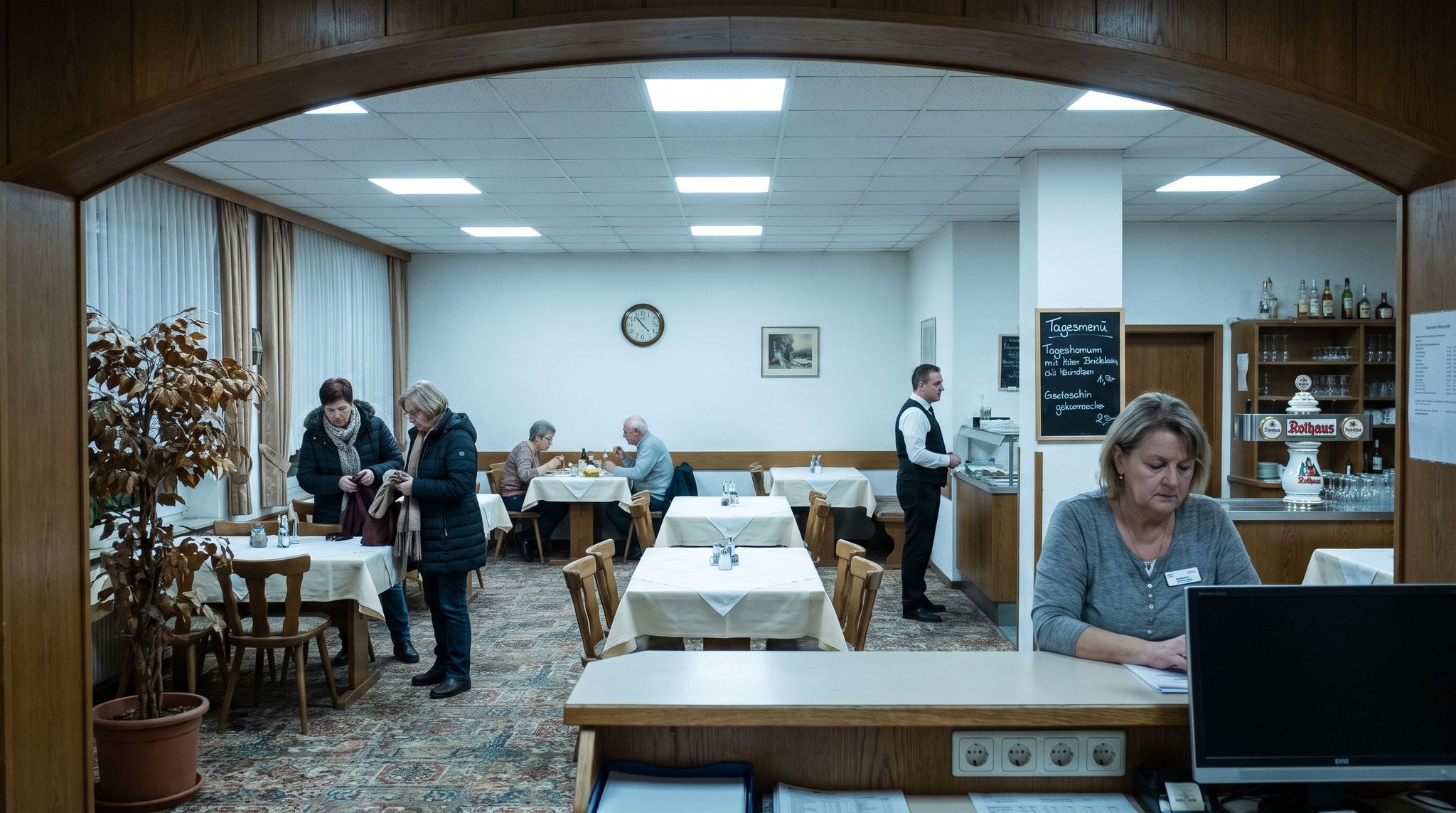
By the time I walked through the lobby, all of that was gone. The lighting was flat. The music was wrong. The front desk greeting was hollow, read from a script nobody believed in anymore. The rooms were clean but dated. The F\&B space had that particular emptiness a room gets when it has stopped being respected. Nothing was broken enough to shock you if you had low expectations. Everything was tired enough to tell you the truth.
The staff told the rest. They were doing tasks but they were not present. No urgency. No pride. The best ones had already left. The ones who remained had learned that effort changed nothing, so they stopped offering it. Guests felt it. They didn't complain. They just didn't come back.
The trade thinned in layers. Midweek occupancy softened first. Corporate accounts quietly dropped off. OTA dependency crept higher and we all know how cut-throat that is. The F\&B outlet went quieter each month. Weekends still gave the illusion the business might work or might work again … one day. It didn't (and continuing the way it was), it never would.
Every fault had a defence already built for it.
Weak reviews: unreasonable guests.
Staff churn: the labour market.
Soft occupancy: the economy.
F\&B losses: rising costs.
When every problem has an external explanation, nobody is left owning the internal decay.
I remember the first night I walked in and it was undeniable. Standing in the lobby looking through to the restaurant during evening service, the owner was still talking about what the hotel had been known for, while the room told a completely different story. Guests leaving without anger, without enthusiasm. Just flat. Happy to put an end to the kind of experience that counts twice. First and last time. That is a dangerous moment in hospitality. Anger can be recovered. Flatness kills quietly.
The hotel was open and trading. But the operation was already eating itself from the inside. Now it was in the red. Badly. What the owners missed was that the team had lost belief long before the books caught up.
The Pattern Nobody Talks About
When a hospitality venue fails, the autopsy is usually quick. Location. Concept. Timing. Undercapitalised. The landlord. Pandemics. Scamdemics. Global you-name-it crisis. An act of God or even just bad luck.
As we’ve seen in recent years, sometimes some of those are real. But in nearly four decades of working inside hospitality businesses, force majeure aside, I have watched more venues eat themselves alive than get killed by the market. The destruction almost always comes from inside. And it almost always follows a pattern.
A Framework From an Unlikely Source
In 1970, a former Soviet KGB operative (his cover was a journalist) named Yuri Bezmenov defected to the West.
In 1984 he gave a television interview that would later become one of the most referenced lectures on institutional subversion ever recorded. Given the defection was in 1970, the timing of that interview was interesting since 1984 was when US/Soviet relations were at their lowest point since the early 1960s, a period often referred to as the "Second Cold War".
Bezmenov had spent years working in India as a propaganda operative before defecting to the West. His area of expertise was not espionage in the conventional sense. It was something quieter and more corrosive: the systematic destabilisation of a target society from within.
Bezmenov described a four-stage process. Not a theory. A methodology. One he had been trained to execute. Journalism was a perfect channel for running it.
Here are the four stages Bezmenov described. Then we will put them on a hospitality floor.
Stage 1: Demoralisation.
The erosion of shared values, confidence, and trust within the target population. Not through force, but through slow, persistent undermining. It takes 15 to 20 years, Bezmenov said, because that is the time required to educate one generation without the corrective influence of the values it is replacing.
Stage 2: Destabilisation.
The structures begin to lose coherence. Institutions that once functioned start pulling against themselves. Decision-making becomes reactive. Internal contradictions multiply. The system looks intact from the outside but is hollowing out.
Stage 3: Crisis.
The visible rupture. What was quietly broken becomes publicly undeniable. The system can no longer absorb the accumulated damage. This stage is fast, often violent, and almost always surprises the people inside the system who assumed things were still holding together.
Stage 4: Normalisation.
The most dangerous stage. Not the crisis itself, but the settlement that follows. The new dysfunction becomes the accepted baseline. People stop expecting better. The abnormal becomes normal. And the window for reversal closes, sometimes permanently.
Bezmenov designed this framework for nation-states. But the mechanics are universal. Any system built on human trust, human effort, and human judgement is vulnerable to the same sequence.
A hospitality venue is exactly that system, compressed into a single building.
Where This Gets Personal
The product in hospitality is the experience. The experience is delivered by people, in real time, with no buffer between what is happening and what the guest perceives. When a tech company has a bad quarter, they adjust a roadmap. When a consulting firm loses a client, they write a new pitch. When a hospitality venue starts to decline, you can feel it the moment you walk through the door.
The air is different. The energy is different. Something in the way the host greets you (or doesn't) tells you everything you need to know about what is happening behind the scenes.
That is what makes this industry uniquely exposed. And uniquely honest. There is nowhere to hide.
So when I say the Bezmenov pattern applies to hospitality, I am not drawing an academic parallel. I am describing what I have watched happen, from the inside, across hotels, restaurants, bars, nightclubs, and cafes on five continents. That hotel I described earlier was not an isolated case. It was a textbook run through all four stages. Most operators who have been in this industry long enough will have watched the same sequence unfold.
Here is how the pattern plays out on the floor.
Demoralisation
The team stops caring. That is the visible symptom. The cause sits with leadership, not the industry.
Hospitality is demanding work. Everyone who chooses it knows that. The hours are long. The weekends belong to the guests. Split shifts are a reality in operations that serve breakfast and/or lunch and/or dinner. Public holidays are often your busiest trading days. The physical and emotional intensity of service is real, and anyone who has spent time on the floor, behind a front desk, or in a commercial kitchen understands the deal. People don't enter hospitality expecting a nine-to-five. They enter it because they are drawn to the craft, the energy, the human connection that makes this industry unlike any other.
The demoralisation doesn't come from the work. It comes from what leadership does, or fails to do, inside those realities.
Ownership that treats front-of-house staff as interchangeable. No career pathways. No development. No voice in how the experience is built. Standards talked about but never enforced. Recognition that is absent. An environment where doing more or doing better makes no visible difference to anyone above you.
People do not leave jobs in an industry they chose and love. They leave leaders.
And when they do, it shows. The best ones go first. The ones who remain learn that effort changes nothing. Eye contact fades. Initiative disappears. Warmth becomes mechanical. The team is still there, still filling shifts, but they are no longer present. The guest feels this within minutes of walking in. They may not name it, but they feel it. The room has a particular quiet when the people working in it have stopped caring. Not silence. Something worse. Indifference.
Guests do not come back to indifference. They just leave and a lot of them take their networks (that you'll never see or know) with them.
Destabilisation
Once the people hollow out, the operations follow. Every time.
Nobody chose to let the roster be chaotic. But nobody built one that prioritised service quality over shift-filling.
Nobody chose to let the guest experience depend on who happened to be working. But nobody invested in common standards, pre-service rituals, or the kind of leadership that makes consistency possible across different teams on different nights.
The gap between the brand promise and the floor reality widens. Management says one thing; the floor does another. The owner walks in and overrides the GM, the chef, or both, with no understanding of the downstream consequences. Everything runs on the heroics of one or two people carrying the operation on their backs, and those people are burning out. When they leave (and they will), the whole thing lurches sideways.
Destabilisation is the difference between what the website says the experience will be and what the guest actually gets at 8pm on a Saturday.
Crisis
The visible collapse. The viral one-star review. The Saturday night where the kitchen goes down and nobody knows the escalation path. The health inspection that exposes what everyone on the floor already knew but ownership refused to hear. The walkout. The no-show. The moment where everything that was quietly broken becomes publicly undeniable.
Hospitality crisis is immediate, visceral, and public. There is no quarterly report to soften it. No PR cycle to manage the narrative before the guest feels the impact. The guest is standing in front of you and the experience is failing in real time.
How the team responds tells you everything about the stages that preceded it. A demoralised team working inside destabilised operations does not rise to a crisis. They fold. They freeze. They look for someone else to fix it. Not because they are weak. Because nothing in the preceding months or years built the capacity for anything else.
A team that has been invested in, led properly, and given genuine ownership of the guest experience handles the same crisis entirely differently. They absorb the pressure. They communicate. They recover. The guest may never know something went wrong. That's not luck. That is architecture.
Normalisation
The most dangerous stage. Not the crisis itself. The settlement that follows.
"That's just hospitality."
The hours. The churn. The burnout. The pay. The revolving door. The acceptance that mediocre is standard and great is unsustainable. The industry shrugs and calls it reality. The owner stops fighting. The team stops expecting better. The guests stop coming. And everyone agrees it was the market.
It wasn't the market.
It was the pattern. Running exactly as designed. Not by a KGB operative, but by the accumulated weight of choices nobody examined and standards nobody enforced.
The exceptional hospitality venues (and they exist, in every market, at every price point, in every segment of this industry) are the ones that refused to normalise the decay. Refused to accept that high staff turnover is just how it is. Refused to treat inconsistency as inevitable. They held standards when it was expensive and uncomfortable to do so, because they understood that normalisation is the point of no return. Once a team accepts dysfunction as baseline, the window for rebuilding becomes vanishingly small.
The Inversion
Every one of those stages has an antithesis. Not a hopeful opposite. A deliberate counter-move that does not happen by accident. It is built.
Demoralisation inverts to CONVICTION.
Teams that believe in what they deliver because the environment earns that belief every shift. Not through motivation. Through investment in people, clarity of purpose, visible career pathways, and an environment where contribution is recognised and standards actually mean something.
Destabilisation inverts to STABILISATION.
Operations that hold on the busiest night of the year because someone invested in systems, in people, and in the leadership architecture that connects them. Pre-service rituals. Clear escalation paths. Standards that do not depend on which supervisor is on. A rhythm that absorbs pressure rather than amplifying it.
Crisis inverts to CONFIDENCE.
The quiet competence of a team that handles pressure because every preceding stage was built properly. Confidence in hospitality shows in how the team handles the 8pm rush, not in a strategy deck. It is earned through preparation, not performed under stress.
Normalisation inverts to OWNERSHIP.
The mindset that refuses to accept dysfunction as inevitable. People who treat the guest experience as theirs, not because someone gave them permission, but because that is how they are wired and how they have been led. They hold standards because the standards matter to them. That cannot be trained into someone with a manual. It has to be built into the environment they work in.
That is the framework this series will unpack. One stage at a time. Each one grounded in what actually happens on the floor, behind the bar, in the kitchen, and at the front desk. Not theory. Operational reality, examined through a lens that explains why some venues thrive while others eat themselves alive.
Why This Matters Now
Hospitality globally is burning through people faster than it can replace them. The post-pandemic talent exodus was not a blip. It was a correction. The people who left were not lazy. They were exhausted, undervalued, and working inside systems that had been running the Bezmenov pattern for years without anyone naming it.
The best operators kept their people because those people had something worth staying for. The rest blamed the labour market and posted another job ad.
At the same time, the industry is consolidating at a pace that is quietly reshaping what hospitality actually looks like. And it is happening everywhere.
In the United States, as at the time of writing, the 10 largest hotel groups control roughly 65 per cent of room supply. Around 80 per cent of American hotels now operate under a franchise model, up from 70 per cent just 15 years ago. Midscale and economy segments dominate the pipeline. On the restaurant side, independent operators declined by 2.3 per cent in 2025 (a net loss of more than 9,500 locations), while chain locations grew by 1.4 per cent. The number of chains with more than 1,000 domestic locations has risen from 30 in 2005 to 46 today.
In Europe, the majority of hotels are still independently owned (roughly 200,000 properties), but the direction is unmistakable. Brand affiliation has risen from around 33 per cent to over 41 per cent in the past decade. In key Western European cities, franchise penetration now exceeds 55 per cent for the first time. Three-quarters of the European hotel pipeline is franchise-based. In Germany alone, branded rooms have crossed 40 per cent of the total market.
In Australia, the picture is acute. Hospitality closures hit a record 9.3 per cent nationally in early 2025\. One in 11 businesses. Insolvencies surged 42 per cent year-on-year. Sixty per cent of venue operators describe their financial health as struggling or dire. The independent operator is being squeezed by mega-groups that absorb higher rents, lock in better supplier terms, and hold prices in ways a standalone venue cannot match. The gap between hospitality groups and independent operators is widening, and it is quietly choking out diversity in favour of bland sameness.
Across Asia-Pacific, the consolidation follows its own pattern. China's hotel market (roughly 320,000 properties) has around 40 per cent of rooms in branded chains. Japan is dominated by chain operators. Investment capital across the region is flowing overwhelmingly into branded, upper-midscale, and luxury properties, with rising labour costs and operational expenses making independence harder to sustain year on year.
None of this is inherently wrong. Franchise models work. Consolidation has its logic. Midscale hospitality serves a real market need. But the cumulative effect, globally, is an industry where the baseline experience is increasingly standardised, increasingly impersonal, and increasingly detached from the human craft that made hospitality worth caring about in the first place.
The venues that are thriving right now, truly thriving, are not the ones that accepted this as the new normal. They built something different. They run a different playbook. And that playbook is the inverse of the pattern that is quietly destroying everyone else.
If you run a hotel, a restaurant, a bar, a cafe, a nightclub, or any venue where the experience is the product and people are the delivery mechanism, this is written for you. Not because it will tell you what you want to hear. Because it will tell you what you already suspect but have not yet said out loud.
The question that matters: Which playbook is your venue running?
If you are honest with yourself, you already know.

This is part one of a six-part series. Next: why demoralisation is the first thing your guests feel, and the last thing most operators address.
Paul Lange advises owners and senior leaders in hospitality and beyond on the decisions that define commercial outcomes and organisational character. He has spent close to four decades across hospitality, finance, technology, professional services, and operating roles on five continents, on both sides of the table, with private equity and venture capital one part of it, and has taken five of his own companies through to exit. He is the creator of the Total QX™ (Total Quality Experience) and TILE Theory™ frameworks, and the author of The 20% Leader, Mis(très)s Entrepreneur Manifesto, Evolve or Be Remembered, and The Inheritance Manifesto. He runs his advisory practice, Manolutions, from the Gold Coast, Queensland. He writes InnSight because exceptional hospitality is not an accident. It is built.