
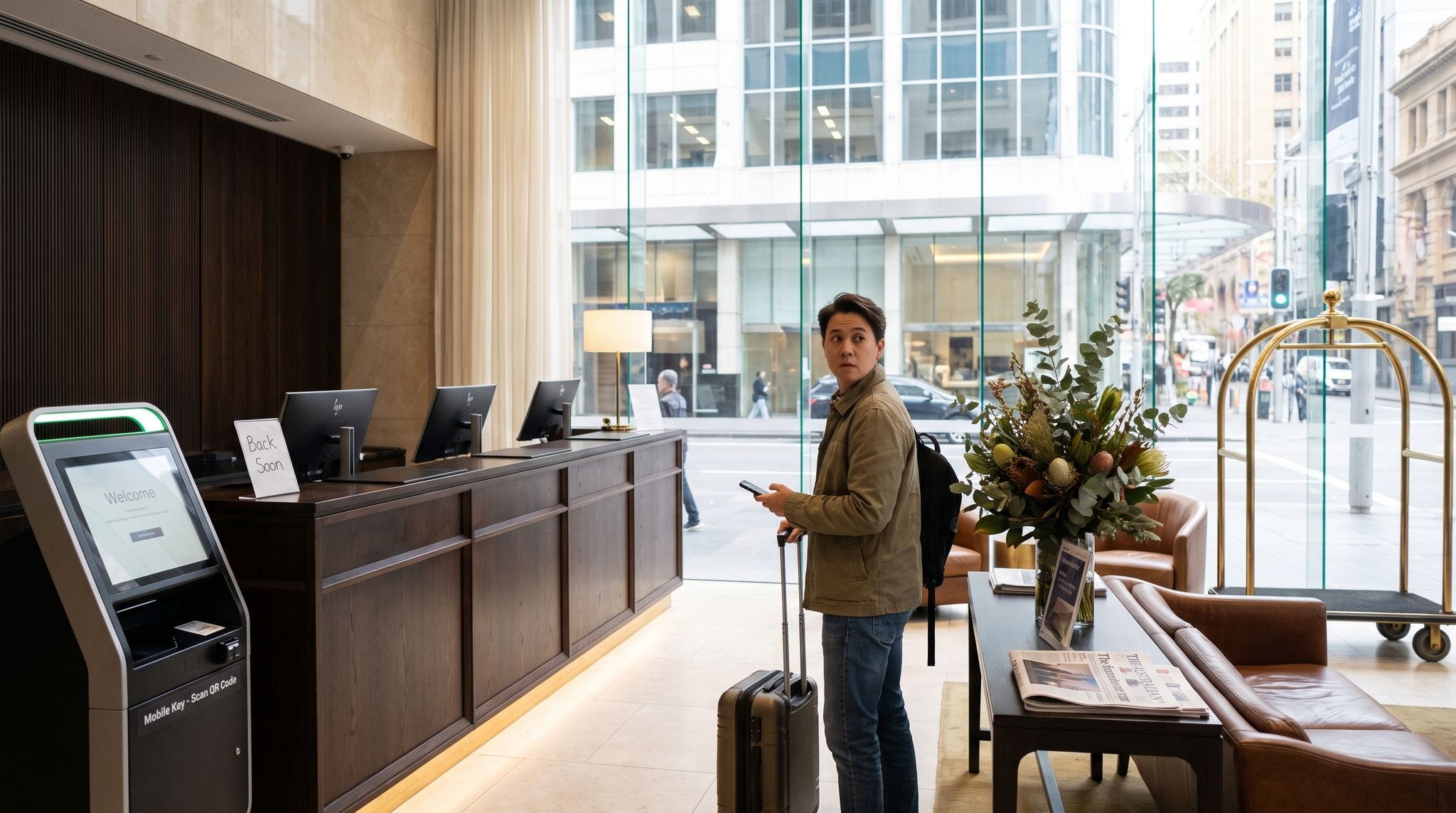
The property had moved from twelve agents at the front desk to three over eighteen months. Mobile keys. App check-in. Room selection on the booking confirmation. A PMS upgrade that surfaced guest preferences to whoever was on shift without three additional taps. The CFO walked me through the labour savings in the kind of voice that has been rehearsed for the board: hours saved per stay, headcount reduction phased to align with attrition, a payback period the integrator had model-defended down to the month.
I asked where the saved hours had gone.
The CFO looked at me as if I had asked an irrelevant question. The saved hours had not gone anywhere. They had been eliminated. The whole point of the deployment was that those hours did not exist any longer. The labour line was lower. The technology line was higher. The net was a margin improvement. The board paper said so.
I asked the duty manager whether the lobby had a permanent presence between two and four in the afternoon. He said no. The system had been very efficient. Nobody was needed there during the quiet hours. The chief concierge had been wound back to part-time. The F&B lead was in the office on a Wednesday afternoon because the kitchen had not asked for anything. The reception agents who remained were efficient, pleasant, and watching screens.
The property had spent two million dollars and eighteen months on a deployment whose entire business case was the time it would save. Then it threw the time away.
The conversation is locked at the wrong level
The industry conversation about hospitality technology and AI is the loudest it has ever been and the least useful. Trade press is split between the evangelists who treat every new tool like a competitive moat and the doom-sayers who treat every deployment as a step toward the unfeeling property. Operators sit between the two camps and pick the one that matches their existing prejudice. Both camps miss what is actually happening in the building.
The question is not whether technology replaces humans. That is the wrong question because the answer is obvious and unhelpful. Some humans, in some roles, on some tasks, yes. Most importantly the transactional ones. Check-in, key issue, room selection, in-room ordering, departure, basic concierge queries. These are getting done by software now and they are getting done well. The agent who used to do them was not delivering anything competitively defensible by doing them. The technology removed work that was not earning the rate it cost.
Just over a month ago I wrote that the bifurcation between hotels and accommodation businesses is decided at the human service layer, and that the transactional layer of the industry has collapsed into the accommodation floor. A couple of weeks back the labour problem got the same treatment: it sits upstream of the wage line, at the selection mechanism in the recruitment funnel. The technology question is a third reading of the same argument. It is the choice the operator makes once the technology has done its part of the work and the human work is what is left.
The right question, the one almost nobody in the industry is asking honestly, is what happens to the time the technology gave back. Because the technology gave time back. That was the business case. That was the integrator's promise. That was the model on the CFO's screen.
Either that time gets reinvested in the work the technology cannot do, or it gets eliminated from the cost base entirely. Same deployment. Same software. Same dashboard. Two opposite outcomes, decided not by the technology but by what the operator chose to do once it was running.
Same technology, two hotels
Two properties I walked through bought the same tech stack last year. The board presentations were almost interchangeable. Mobile keys, app check-in, AI-assisted revenue management, PMS automation that consolidated three legacy systems into one workflow. The integrator was the same firm. The deployment teams overlapped.
Property One reduced headcount by 30 per cent across the front office. The savings dropped to the bottom line. The board congratulated the GM. The owner congratulated the CFO. The deck for the institutional refinance carried a labour-cost-per-occupied-room number that put the property in the top quartile of its competitive set. The technology had performed exactly as promised.
Property Two reduced headcount by the same 30 per cent across the same roles. Then it reinvested half of the saved labour budget into the experience layer. The duty manager moved permanently into the lobby during peak hours. The F&B lead was on the floor during dinner service every night for the first month, then five nights a week, then four. The housekeeping rotation was reshaped so the team had time to notice and anticipate in-room, not just clean and reset. A guest recognition role was created that did not exist before, reporting jointly to front office and F&B. A property historian (someone who could actually tell a guest something about the building, the city, the neighbourhood beyond what the app would have shown them) was added at part-time. The labour-cost-per-occupied-room came down too. Less than Property One's. But it came down.
Twelve months later the ADR spread between the two properties had widened by 18 per cent. The retention spread had widened by more. Property One was efficient at being a slightly cheaper version of itself. Property Two had used technology to move further up the rate card than it had been able to justify before.
Two properties can run identical tech stacks. One is a hotel. The other is an accommodation business with mobile check-in.
The technology was not the variable. The intent was.
Speed up to slow down
The principle is structural, and it is the only frame I have found that makes the technology decision rational rather than reactive.
Speed up the transactional. Slow down the experiential. Use the first to fund the second.
The transactional work in a hospitality business is everything the guest does not want to spend time on. Standing at a reception desk while an agent looks for a booking. Waiting for a coffee at breakfast while someone behind the counter prints a folio. Filling out the same form three times across the property. Repeating a dietary preference that was already in the booking. None of this is the thing the guest paid for. None of it justifies a single dollar of the rate. The faster the property can move a guest through these moments, the more time the guest has for the thing they actually came for.
The experiential work is the inverse. It is the conversation in the lobby that turned into a recommendation that turned into a memory. It is the F&B lead reading a table and lengthening the pace before the guests realised they wanted it lengthened. It is the duty manager noticing the third visit by the same business traveller and acting on it before being asked. It is the kind of moment that takes time, and that only happens if the person whose job it was to deliver it has been given the time.
Speed-up-to-slow-down means using the first kind of time saving to fund the second kind of presence. The technology was always supposed to be subordinate to that move. It is the tool. It is not the strategy. The strategy is the redirection of time.
This is not new. The principle is older than the technology. The grand hotels of the European belle epoque understood it. The clipboard at the door, the head waiter who knew every regular's preferred table, the night porter who knew the city. The transactional work was as fast as the technology of the time allowed. The experiential work was as slow as the guest could be persuaded to enjoy. Time was the currency. Time is still the currency. Time is the luxury this industry has always sold.
What changed is that the time-saving tools available to operators are now genuinely powerful in a way the manual technologies of the twentieth century were not. The implication is bigger, not smaller. The capacity to redirect time into the human work has expanded by an order of magnitude. The properties that understand this are taking the capacity and using it. The properties that do not are taking the capacity and burning it.
How the human layer is lost
The pattern by which the foundations of exceptional hospitality are methodically eroded looks very tame in this version. There is no antagonist. There is no announcement. There is no decision to dismantle the human layer. There is only a recurring failure to redirect time when it becomes available. The transactional layer accelerates. The hours come back. The hours disappear. The next deployment makes the same case. The hours come back. The hours disappear. Two cycles later the human work the property used to do is not done by anyone, and nobody can quite remember when it stopped.
This is how the human layer is lost. Not in a single decision. In a thousand small choices not to redirect.
The CFOs running these deployments are not malicious. The board members signing off on them are not anti-hospitality. The integrators are not selling snake oil. Every single party in the deployment chain is doing exactly what they have been hired to do. The model defends. The board approves. The integrator delivers. The technology works. The hours are saved. The hours disappear. The transactional layer is faster. The experiential layer is thinner. The board congratulates the GM. The guest, two stays later, books somewhere else.
Nobody chose to dismantle the human layer. That is what makes the dismantling so reliable. The choice is the one nobody is making, repeatedly, until what was there is no longer there.
The Total QX™ touchpoint audit, pointed at the digital-human seam
The diagnostic for an operator working through a technology deployment is a Total QX™ touchpoint audit run specifically along the digital-human seam. Walk the property. At every touchpoint the guest has with the building, ask three questions.
Does this touchpoint require a human to be present for the moment to feel earned?
If the answer is no, automate it as aggressively as the technology permits. Mobile check-in. App-based room selection. In-room ordering. Digital invoicing on departure. These have collapsed into the accommodation floor. They are not differentiators. They are table stakes. Any operator running them only on humans is paying for table stakes at differentiator rates.
The qualifier the spreadsheet does not surface is this. Automate is not the same as eliminate. The eighty-year-old guest, travelling more than ever and perfectly capable, still wants the option of a person to look up when they walk in. The thirty-year-old guest, app-fluent and silent through check-in, still appreciates the human in the lobby on the bad day, the awkward request, the moment the technology cannot read. The property that automates the touchpoint and then removes the person from the building entirely has answered a question nobody asked. Automate the function. Keep the person available. Available is not idle. Available is the work.
If the answer is yes, ring-fence it. The touchpoint that requires a human presence is now part of the property's entire competitive surface. There is nowhere else for the differentiation to live. Everything below this line is being delivered by software at every property in the market. The human layer is the only thing left that one property can deliver and another cannot.
Is the human currently delivering this touchpoint actually present, or are they processing the next one?
This is the question most operators avoid. The reception agent who is "available" for the guest in the lobby but is also booking transport, handling the in-house dial-up, monitoring three booking channels and triaging a maintenance ticket is not present. They are processing. The presence the touchpoint requires has been backfilled with productivity demands the touchpoint cannot survive. Technology was supposed to clear the processing load so the presence could return. If presence has not returned, the deployment is incomplete regardless of what the dashboard says.
If the technology released this person's time, where did that time go?
Where the answer is the cost line, the property has used the technology to make itself more efficient at being an accommodation business. Where the answer is the lobby, the F&B floor, the in-room work the guest never sees but feels, the recognition system, the slow conversation that turns into a guest's reason to come back, the property has used the technology to become more of a hotel.
There is no almost. The hours either went back into the human work or they did not. The board paper either records the redirection or it records the elimination. The operator either chose presence or chose cost. The technology is silent on which one happened. The decision is the operator's.
The capital allocation tell
The capital allocation question underneath this is the one private equity and institutional investors should be asking the hardest, and almost never do.
Most hospitality technology pitches end in a labour-savings number. The integrator has a model. The CFO accepts the model. The model defends the deal. None of this is wrong. It is incomplete. The number on the model is the gross time saving. The net operating decision is what happens to that time once it is freed up. A property that takes the saving straight to the cost line is converting a strategic opportunity into a one-time margin improvement. The technology is doing its job. The capital allocation is misreading what the job was.
A property that redirects half or more of the saved labour budget into ring-fenced human presence at the touchpoints that earn the rate is using the technology as it was always supposed to be used. The model gets a smaller direct margin improvement and a much larger rate and retention improvement that the model usually does not capture cleanly. Three years out the second property wins, by more than the dealmakers expected and at margins that are more defensible through a cycle.
The institutional investor who underwrites the property as a cost-out story is underwriting the wrong thesis. The institutional investor who underwrites the property as a time-redirection story is closer to the truth, and is also a rarer animal. Most institutional capital in this sector still reads hospitality as a real estate asset with an operating business attached. The operating business is the entire investment. The real estate is the wrapper. The technology decision is one of the cleanest tells the asset gives about which kind of operator is running it.
If I am underwriting a property today, I am asking three questions of the operator before I touch the deck. What has technology saved you in labour hours over the past two years. Where did those hours go. Show me the line item. If the answer is the cost reduction line, the asset is being managed as accommodation regardless of what the rate card says. If the answer is a named experience role, a re-staffed touchpoint, or a defined presence standard on the floor, the operator is using the technology the way the asset was built to be used. The rate is being earned, not borrowed.
The harder truth
The technology is not the variable. The operator's intent is.
Two properties running identical tech stacks will land in opposite places three years out, and the difference will not be the deployment. It will be the decision, taken a hundred times across small daily choices, about where the saved time goes. The decision is not technical. It is not strategic in the deck sense of the word. It is personal. It belongs to the operator and to nobody else. The choice to redirect hours into the human work, or to let them collapse into the cost line, is sovereign.
The properties that get this wrong will not look bad immediately. The margin improvement will show up. The board will be pleased. The deck will be cleaner. Then the rate will start to soften, the retention spread will start to widen against the competitor that made the other choice, and by the time the GM is being asked what changed, the answer will be three years upstream of where they are looking.
The operator who treats technology as an end has used it to become a slightly more efficient version of themselves. The operator who treats it as a means has used it to buy back the thing the rate was always supposed to be paying for.
The technology gave you the time. What you did with it is the entire question.

Paul Lange advises owners and senior leaders in hospitality and beyond on the decisions that define commercial outcomes and organisational character. He has spent close to four decades across hospitality, finance, technology, professional services, and operating roles on five continents, on both sides of the table, with private equity and venture capital one part of it, and has taken five of his own companies through to exit. He is the creator of the Total QX™ (Total Quality Experience) and TILE Theory™ frameworks, and the author of The 20% Leader, Mis(très)s Entrepreneur Manifesto, Evolve or Be Remembered, and The Inheritance Manifesto. He runs his advisory practice, Manolutions, from the Gold Coast, Queensland. He writes InnSight because exceptional hospitality is not an accident. It is built.